Mid-Career Crisis: What It Is and How to Handle It
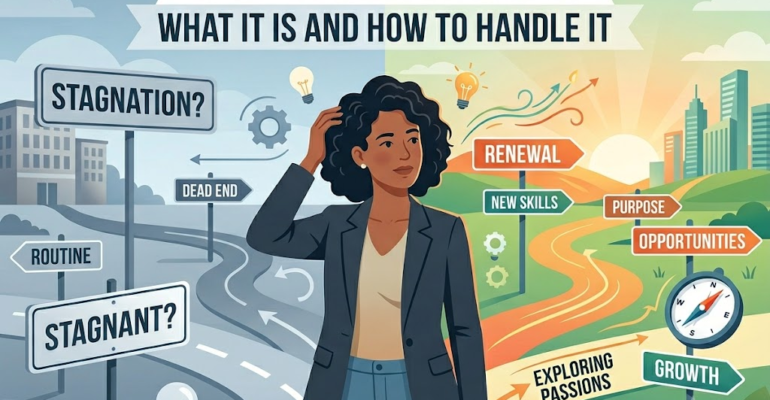
Mid-Career Crisis: What It Is and How to Handle It
Let me ask you something.
You have a job. Maybe even a good one. Your salary hits your account every month. Your parents are proud of you. Your LinkedIn profile looks great.
But somewhere deep inside – you feel empty.
You drag yourself to work. You sit through meetings that feel pointless. You come home tired, not because of the workload, but because something inside you is slowly losing interest.
Sound familiar?
If yes – you are not going through a phase. You are not being ungrateful. And you are definitely not alone.
What you are experiencing has a name. It is called a mid-career crisis. And it is far more common in India than anyone talks about.
So What Exactly Is a Mid-Career Crisis?
Think of it this way.
Remember when you were in college, full of ideas about what you wanted to do with your life? Maybe your parents suggested engineering. Maybe your school counsellor said “take science, good scope hai.” Maybe you just went with what your friends were doing.
Fast forward 8, 10, or 12 years. You followed the path. You worked hard. You got the job, the promotions, maybe even a house and a car.
But now you are sitting at your desk wondering – “Is this really it? Is this what the next 25 years of my life look like?”
That feeling – that quiet restlessness – is a mid-career crisis.
It usually hits somewhere between the ages of 28 and 45. It is not burnout from overwork. It goes much deeper. It is the gap between the life you are living and the life you actually want to live.
Who Does This Happen To?
Honestly? It can happen to anyone. But in my experience of working with thousands of professionals across India, I see certain patterns again and again.
The software engineer in Bangalore or Pune who is 9 years into his career, earning well, but feels like a machine — same standup calls, same tickets, same process every single day.
The bank manager in a tier-2 city who started with so much energy but now feels like every day is a copy-paste of the day before.
The school teacher who genuinely loved teaching at first, but now feels underpaid, overlooked, and creatively dead.
The middle manager at a corporate job who got every promotion on time but one day realised the ladder she climbed was leaning against the wrong wall.
The entrepreneur who built a business from scratch, but woke up one morning feeling completely disconnected from why he started it in the first place.
Does any of this sound like your life?
The point is a mid-career crisis does not care about your salary, your designation, or your city. It happens to successful people. It happens to hardworking people. It is an inside feeling, not an outside failure.
7 Signs Your Career Crisis Is Real (Not Just a Bad Week)
Sometimes we brush off these feelings as “just stress” or “yaar sab ke saath hota hai.” But there is a difference between a rough week and a genuine mid-career crisis. Here is how you can tell:
- Work feels like a burden, not a purpose You used to look forward to your projects. Now you are watching the clock. Tasks that once excited you feel like a burden you just want to get off your plate.
- You keep imagining a completely different life Maybe you secretly want to start something of your own. Maybe you wish you had chosen a different field entirely. You find yourself daydreaming “What if I had become a…”
- You feel a sting when you see others loving their work When your friend talks passionately about their startup, or your cousin seems genuinely happy in her new role, you feel a mix of happiness for them and a quiet sadness for yourself. Because you do not feel that way about your own work anymore.
- Your best effort has quietly become your average effort You are capable of more. You know it. But you just cannot bring yourself to give it fully. The motivation is simply not there.
- Work stress is affecting your personal life You come home irritable. You snap at your family over small things. You have stopped meeting friends. You feel mentally drained even on weekends. Your work is bleeding into your personal peace.
- You think about switching careers but freeze every time The idea of doing something different excites you. But then the questions start “What will people say? What about my EMIs? What if I fail? I am 34 already, too late nahi ho gaya kya?” And you stay stuck.
- Every year feels like a replay No new skills. No new challenges. No real growth. Just the same role with a slightly higher salary and a slightly lower enthusiasm.
If you nodded to 3 or more of these your inner voice is telling you something important. It is time to listen.
Why Does This Happen?
Here is the honest truth most people do not want to hear.
Most of us in India chose our careers based on what others expected from us not based on who we actually are.
Your 10th board marks decided your stream. Your 12th percentage decided your college. Your placement package decided your job. Somewhere in all of this, you your personality, your strengths, your interests got left behind.
And for a few years, that is okay. You are busy building your career, settling down, earning money. But by your late 20s or 30s, the real you starts knocking from the inside. And the mismatch between who you are and what you do every day becomes impossible to ignore.
Add to that the fact that you as a person have grown. What felt exciting at 24 may not be enough at 36. Your values change. Your priorities change. What once gave you satisfaction may no longer be enough.
This is not weakness. This is called being human.
How to Actually Handle a Mid-Career Crisis
Okay. So you are in one. Now what?
Here is what I tell every professional I work with a mid-career crisis is not a problem. It is a signal. And if you handle it correctly, it can be the best turning point of your professional life.
Step 1: Stop pretending everything is fine
The worst thing you can do is push the feeling down. Ignore it long enough, and it turns into depression, health problems, broken relationships. The first step is simply to acknowledge “Something is not right, and I need to figure out what.” That honesty is the beginning of clarity.
Step 2: Sit down and ask yourself the real questions
Not the LinkedIn-profile version of yourself. The real you.
What did you love about your work when you first started and when exactly did that change? What kind of work makes you forget to check your phone? If your salary stayed the same no matter what you did, what would you actually choose to do? What do you want your work life to look like 5 years from now?
Write these answers down. Do not just think them write them. There is something powerful about putting your thoughts on paper. It forces honesty.
Step 3: Get a psychometric assessment done
This is the step most people skip and it is the most important one.
A psychometric career assessment is not one of those 10-question online quizzes. It is a proper, science-backed evaluation of your personality, your aptitude, your work style, and your natural strengths. The kind that gives you a detailed 22+ page report and actually maps your profile to careers that genuinely suit you.
I have worked with hundreds of professionals in India who were completely surprised by what their assessment revealed. A finance professional who discovered she was actually wired for creative direction. An IT manager who realised his real strength was in people and strategy, not code. A school teacher who found that corporate training was a perfect fit for everything she naturally does well.
You cannot solve a puzzle without first seeing all the pieces clearly. A psychometric assessment gives you those pieces.
Step 4: Separate your fears from the actual facts
A lot of what keeps you stuck is not reality it is fear wearing the costume of logic.
“I am too old” No you are not. I have helped people make successful career shifts at 38, 42, even 47.
“I will have to start from scratch” Rarely true. Most career shifts build on skills and experience you already have.
“Log kya kahenge” The people worried about what others will think are the ones who never make a change and regret it at 55.
Write down your fears. Then, next to each one, write the actual evidence. You will find that most fears shrink the moment you examine them honestly.
Step 5: Explore quietly, before you decide anything
You do not need to quit your job tomorrow. In fact, please do not.
Start small. Talk to 2 or 3 people who work in a field you are curious about. Take one short course in a skill you want to develop. Ask your HR if there are internal roles in your company that might interest you more. Start a side project on weekends.
Exploration is not disruption. You are not burning anything down. You are just opening windows to see what the view looks like.
Step 6: Talk to someone who actually knows what they are doing
A mid-career crisis is one of the biggest decisions of your life. Please do not handle it alone, and please do not take advice from well-meaning friends and family who have never been through it.
A good career coach one who uses proper assessments, understands personality science, and has actually helped people through career transitions can save you years of confusion.
The difference between making a career decision based on emotion versus making one based on clarity and data is enormous. One keeps you stuck or sends you in the wrong direction. The other sets you free.
Step 7: Take one small step this week — just one
Clarity without action is just a nice thought. You do not need a full plan on day one. You just need one step.
Send one email to someone in a field you are curious about. Book one career consultation. Enroll in one short course. Update your resume. That is it.
Every big career transformation in India that I have seen — and I have seen thousands started with one person deciding to take one small step forward.
What You Should NOT Do
A few things I see professionals do during a mid-career crisis that make things worse:
Do not quit your job in a moment of frustration. That bad meeting, that unfair appraisal do not let one bad day make a 10-year decision. Wait until you have a direction.
Do not compare your journey to your college batchmates. Rahul’s promotion or Priya’s startup success has nothing to do with your path. Everyone’s timeline is different.
Do not go looking for a magic answer. There is no one course, one YouTube video, or one motivational seminar that will fix this. It takes honest reflection, proper assessment, and a clear plan.
Do not stay silent. Suffering quietly and hoping the feeling passes is not a strategy. Reach out. Talk to a mentor, a coach, or someone you trust completely.
“But I Am Already 35 / 38 / 40. Isn’t It Too Late?”
I get asked this question almost every week. And every time, my answer is the same.
No. It is not too late.
Some of the most inspiring career shifts I have personally guided happened after the age of 35. A 39-year-old IT professional in Hyderabad who became a career counsellor himself. A 41-year-old bank officer in Lucknow who transitioned into financial coaching. A 37-year-old marketing manager who built a successful content business from scratch.
Age is not your enemy. Confusion is. And confusion has a solution.
The only thing that is actually too late is waiting another 5 years to do something about it.
One Last Thing
Your career crisis is not a sign that you made the wrong choices. It is a sign that you have grown and your work needs to grow with you.
You are not stuck because you are not capable. You are stuck because you have not yet found the direction that truly fits who you are today.
That direction exists. I promise you it does. You just need the right tools, the right guidance, and the courage to look for it.
Ready to Find Your Direction?
If any part of this blog felt like it was written for you it probably was.
Book a Career Clarity Session or a Psychometric Assessment for Professionals with me, and let us figure this out together. No generic advice. No motivational lectures. Just honest, science-backed guidance that gives you a real answer.